
You've Practiced. You've Tried.
So Why Are You Still Stuck?
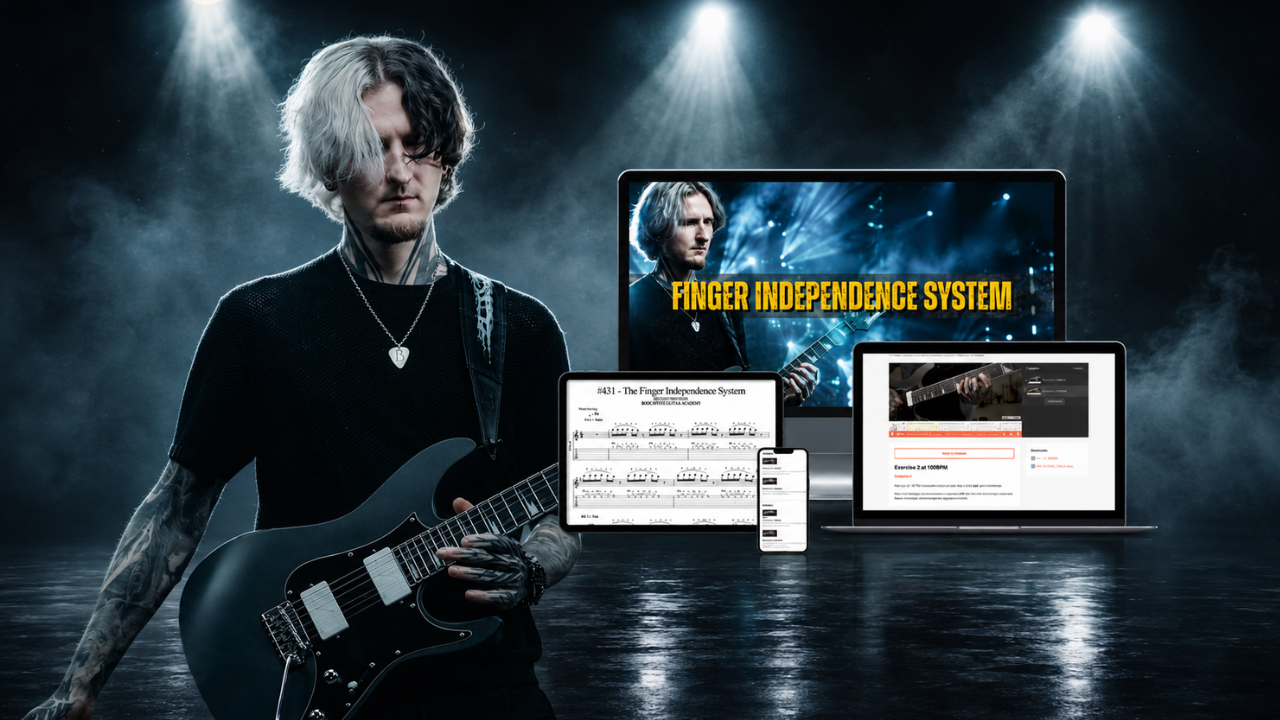
YES — I Want The Finger Independence System
Why Your Fretting Hand Falls
Apart At Speed
Maybe this sounds familiar.
You practice consistently. You work with a metronome. You slowly build the tempo.
And for a while, everything feels like it's improving.
Then you hit that wall.
Your hands stop cooperating. Your speed disappears. Your fingers feel weak. Tension takes over. And the clean passage you've played a hundred times turns into a mess.
So you try harder. You try new exercises. You buy another course.
But somehow… you're still stuck.
After working with more than 50,000 guitar players, I've seen the same hidden issue show up again and again.
It's called index finger anchoring.
Most players don't know they're doing it.
The index finger quietly becomes a stabilizer for the entire fretting hand. It feels natural. It feels comfortable.
But it creates a problem:
The ring finger and pinky never learn to operate independently. They're constantly leaning on the index finger for support. And eventually that creates a mechanical ceiling that no amount of effort can push through.
The symptoms are easy to recognize:
- ✔️ You can play it slowly — but everything falls apart when the speed goes up.
- ✔️ Your ring finger and pinky feel slower, weaker, or less dependable than the rest of your hand.
- ✔️ The harder you push the tempo, the more tension takes over.
- ✔️ Your picking hand and fretting hand both work fine alone — but together they refuse to sync.
- ✔️ Difficult runs make your hand feel unstable, shaky, or out of control.
- ✔️ You've been stuck at the same speed ceiling for so long you're wondering if it will ever change.
If that sounds painfully familiar…
Good.
Because it means you've finally found the real source of the problem.
And once you can see it, you can start fixing it.
What Changes When You Fix The Root Cause
For years, you've probably assumed the problem was speed. Or practice time. Or hand size. Or talent.
It wasn't.
The problem was that your fingers never learned to work independently. And when that happens, every other issue starts stacking up.
Here's what changes when you eliminate index finger anchoring:
- ⭐️ Your hands finally synchronize. That feeling where both hands work fine alone but fall apart together? It starts disappearing — because the fretting hand is no longer relying on one finger to do the work of four.
- ⭐️ Your ring finger and pinky stop holding you back. The fingers that always felt weaker and less reliable finally develop the independence they were missing all along.
- ⭐️ Your playing gets cleaner without trying so hard. Less string noise. Less sloppy movement. Less feeling like your fingers are tripping over each other during difficult passages.
- ⭐️ The speed ceiling finally starts moving. Not because you're practicing more — because you're removing the mechanical bottleneck that's been limiting your hand the entire time.
- ⭐️ The tension starts going away. Independent fingers move more efficiently. Less effort. More control. Less fatigue as the tempo increases.
- ⭐️ It works in 10–20 minutes a day — at any age. This isn't about practicing more. It's about fixing mechanics. And mechanics can be improved whether you're 25 or 55.
Because here's the truth:
Most guitar players spend years trying to improve the symptoms.
Very few ever fix the thing causing them.

Learn From One Of The Most Watched
Guitar Teachers In The World
Over the years, I've worked with thousands of players who thought they had a speed problem. Or a synchronization problem. Or a weak pinky problem.
In many cases, they were all dealing with the same hidden issue — and they didn't even know it.
That's why I built The Finger Independence System.
The 4 Exercises That Fix
What's Been Holding You Back
Each exercise targets a different symptom of index finger anchoring. Together, they rebuild the independence, control, and synchronization most players never develop.
- ✅ Exercise 1: The "Oh… That's My Problem" Drill — Remove the index finger completely. Force the ring finger and pinky to work alone. For many players, this is the moment they finally understand why their hand has always felt weak.
- ✅ Exercise 2: Break The Dependency — Arpeggio patterns that constantly move across strings — making anchoring impossible. If your hand falls apart when things get complicated, this is where that starts changing.
- ✅ Exercise 3: Expose The Speed Breakdown — Most players think they have a speed problem. What they actually have is a synchronization problem. This exercise reveals exactly where your hands stop working together.
- ✅ Exercise 4: Feel It In Real Music — Take everything you've built and apply it in a real shred run. Not an isolated drill — a musical passage where you can feel each finger doing its job independently.
- ✅ Two Training Tempos Per Exercise — Slow tempos to build control and precision. Faster tempos to build real-world speed. Instead of guessing why your playing falls apart at tempo… you systematically fix the reason.

Everything You Need To Finally Fix The Problem
- ✅ 4 Finger Independence Exercises — targeting the hidden flaw limiting your speed and control
- ✅ The "Oh… That's What's Wrong" Discovery Exercise — exposes how much your hand depends on the index finger
- ✅ Slow-Tempo Training Videos — build control and precision first
- ✅ Fast-Tempo Training Videos — fix the moment where everything usually falls apart
- ✅ PDF Tabs For Every Exercise
- ✅ Guitar Pro Files For Every Exercise
- ✅ Backing Tracks With Guitar — hear how each exercise should sound
- ✅ Backing Tracks Without Guitar — test your independence on your own
- ✅ The Complete Finger Independence eBook — focus points, common mistakes, and the science behind each exercise
- ✅ The BPM Ladder Progression System — a proven roadmap for building speed without sacrificing accuracy
- ✅ A 10–20 Minute Daily Practice Framework — built for players with jobs, families, and limited time
- ✅ No Intros. No Filler. Press Play And Practice.
Built For Players Who Are Tired Of:
- ✔️ Watching speed disappear when the tempo goes up
- ✔️ Fighting weak ring fingers and pinkies
- ✔️ Feeling tension take over their playing
- ✔️ Wondering why their hands won't synchronize
- ✔️ Practicing for months without knowing what's actually missing
- ✔️ Working hard without seeing the progress they expected
Imagine If Your Hands Worked Like This
Players Are Already Discovering
What's Been Holding Them Back
I learned to shred and sweep pick largely because of Bernth. But after this, I realized I have the finger anchoring problem — and it's exactly why my speed stopped improving.
I've transformed so much after finding this channel. I'm totally inspired again.
The moment I play faster, my index finger wants to move. I never realized how much it was affecting my hand.
Your free lessons are already helping. Professional, direct, and no sugarcoating.
Here's Everything You're Getting Today
- ✅ The Complete Finger Independence System
- ✅ 4 Progressive Exercises (2 Tempos Each)
- ✅ The Discovery Exercise That Exposes The Problem
- ✅ Slow-Tempo + Fast-Tempo Training Videos
- ✅ Full PDF Tab Pack
- ✅ Guitar Pro Files
- ✅ Backing Tracks With + Without Guitar
- ✅ The Complete Finger Independence eBook
- ✅ The BPM Ladder Progression System
- ✅ 10–20 Minute Daily Practice Framework
- ✅ No Filler — Every Minute Counts
Try It For 14 Days, Risk-Free
If the Finger Independence System doesn't help you feel less stuck, more in control, and more confident in your playing, we'll refund your purchase.
No questions asked. The risk is ours.
Frequently Asked Questions
What if index finger anchoring isn't my problem?
If your speed disappears at tempo, your hand tenses during hard passages, or your ring finger and pinky feel weak — there's a strong chance anchoring is involved. Exercise 1 makes it obvious within minutes.
I only have 10–15 minutes a day.
That's exactly who this was built for. The entire daily routine takes 10–20 focused minutes.
Is this only for advanced players?
No. The exercises target a mechanical issue, not a skill level. Whether you're building foundations or breaking a plateau, the process scales to you.
I'm 40, 50, or older. Did I start too late?
No. The problem isn't age — it's mechanics. And mechanics can be improved at any stage of your playing.
I've been stuck for years. Why would this be different?
Because most players spend years treating symptoms — more scales, more speed drills. This targets the hidden habit underneath the symptoms. That's a different approach.
I've tried finger independence exercises before.
Most train strength or dexterity in general. This specifically targets index finger anchoring — the hidden dependency that limits speed, control, and sync for years without players knowing.
What if it doesn't work for me?
14 days. Full system access. If you don't feel more control and confidence in your fretting hand, full refund. No questions.
Do I need Guitar Pro?
No. PDF tabs included. Guitar Pro files are a bonus for players who want more control over their practice.
Instant access?
Yes. Start training within minutes of purchase.
Maybe You Were Missing This.
How many hours have you already spent trying to solve this problem? How many exercises? How many years?
Now you know what's actually been holding you back.